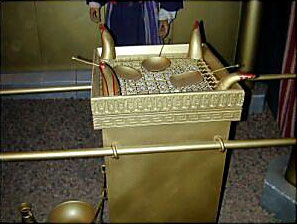
Showing posts with label Altar of Incense. Show all posts

Monday, November 19, 2018

Jeremiah Hides the Tent, Ark, and Altar

This chapter in 2 Maccabees is writing about the time of the defeat and exile of Judah, which would have been several hundred years before this writing. It gives a record of what actually happened to the holy items of the Temple of Solomon, without actually giving the exact location. It seemed that Jeremiah had planned the preservation of the holy Temple items. Firstly, Jeremiah ordered that the Law and Commandments itself must be kept by the people in their hearts. Secondly, the important items such as the Tent, Altar of Incense and Ark of the Covenant were brought up to the mountain of Moses, and sealed in a cave. The location would be kept secret until God reveals it to a future generation.

It is also stated that Nehemiah build a library to collect "books about the kings and prophets, and the writings of David, and letters of kings" so that the history of Israel and its people might be preserved. This practice was also done by Judas, assuming Judas Maccabees. So the temple artifacts, scriptures and history are preserved for the future where they anticipate that God will restore all things including the inheritance, the kingdom and the priesthood. This chapter ends with a paragraph describing the work to preserve the history.


2 Maccabees 2 (RSVCE)
Jeremiah Hides the Tent, Ark, and Altar
2 One finds in the records that Jeremiah the prophet ordered those who were being deported to take some of the fire, as has been told, 2 and that the prophet after giving them the law instructed those who were being deported not to forget the commandments of the Lord, nor to be led astray in their thoughts upon seeing the gold and silver statues and their adornment. 3 And with other similar words he exhorted them that the law should not depart from their hearts.

4 It was also in the writing that the prophet, having received an oracle, ordered that the tent and the ark should follow with him, and that he went out to the mountain where Moses had gone up and had seen the inheritance of God. 5 And Jeremiah came and found a cave, and he brought there the tent and the ark and the altar of incense, and he sealed up the entrance. 6 Some of those who followed him came up to mark the way, but could not find it. 7 When Jeremiah learned of it, he rebuked them and declared: “The place shall be unknown until God gathers his people together again and shows his mercy. 8 And then the Lord will disclose these things, and the glory of the Lord and the cloud will appear, as they were shown in the case of Moses, and as Solomon asked that the place should be specially consecrated.”

9 It was also made clear that being possessed of wisdom Solomon[a] offered sacrifice for the dedication and completion of the temple. 10 Just as Moses prayed to the Lord, and fire came down from heaven and devoured the sacrifices, so also Solomon prayed, and the fire came down and consumed the whole burnt offerings. 11 And Moses said, “They were consumed because the sin offering had not been eaten.” 12 Likewise Solomon also kept the eight days.

13 The same things are reported in the records and in the memoirs of Nehemi′ah, and also that he founded a library and collected the books about the kings and prophets, and the writings of David, and letters of kings about votive offerings. 14 In the same way Judas also collected all the books that had been lost on account of the war which had come upon us, and they are in our possession. 15 So if you have need of them, send people to get them for you.

16 Since, therefore, we are about to celebrate the purification, we write to you. Will you therefore please keep the days? 17 It is God who has saved all his people, and has returned the inheritance to all, and the kingship and priesthood and consecration, 18 as he promised through the law. For we have hope in God that he will soon have mercy upon us and will gather us from everywhere under heaven into his holy place, for he has rescued us from great evils and has purified the place.

The Compiler’s Preface
19 The story of Judas Maccabe′us and his brothers, and the purification of the great temple, and the dedication of the altar, 20 and further the wars against Anti′ochus Epiph′anes and his son Eu′pator, 21 and the appearances which came from heaven to those who strove zealously on behalf of Judaism, so that though few in number they seized the whole land and pursued the barbarian hordes, 22 and recovered the temple famous throughout the world and freed the city and restored the laws that were about to be abolished, while the Lord with great kindness became gracious to them— 23 all this, which has been set forth by Jason of Cyre′ne in five volumes, we shall attempt to condense into a single book. 24 For considering the flood of numbers involved and the difficulty there is for those who wish to enter upon the narratives of history because of the mass of material, 25 we have aimed to please those who wish to read, to make it easy for those who are inclined to memorize, and to profit all readers. 26 For us who have undertaken the toil of abbreviating, it is no light matter but calls for sweat and loss of sleep, 27 just as it is not easy for one who prepares a banquet and seeks the benefit of others. However, to secure the gratitude of many we will gladly endure the uncomfortable toil, 28 leaving the responsibility for exact details to the compiler, while devoting our effort to arriving at the outlines of the condensation. 29 For as the master builder of a new house must be concerned with the whole construction, while the one who undertakes its painting and decoration has to consider only what is suitable for its adornment, such in my judgment is the case with us. 30 It is the duty of the original historian to occupy the ground and to discuss matters from every side and to take trouble with details, 31 but the one who recasts the narrative should be allowed to strive for brevity of expression and to forego exhaustive treatment. 32 At this point therefore let us begin our narrative, adding only so much to what has already been said; for it is foolish to lengthen the preface while cutting short the history itself.

Thursday, September 1, 2011

Uzziah of Judah Grew Strong But Pride Let to Leprosy


After several predecessors who started by walking right with God, then fell, King Uzziah of Judah also seemed to start off correctly with God, and did so for most of his reign. Note that the scripture pointed out that "as long as he sought the LORD, God made him prosper" - this should apply to us all too.

He went out to subdue the Philistines after they had rebelled during the previous kings of Judah. Uzziah was successful in this because he LORD was on his side, and he also managed to have victories against the Arabians and the Meunites. The Ammonites continued to bring tributes to him and his strength became well known.

Among other reforms were fortifying Jerusalem and Judah. For agriculture, he dug more wells for the livestock and expanded the farmers and vinedresses to the mountains and in Carmel. He strengthened the military of Judah and promoted the invention of new war machines and developed new warfare skills.

His downfall came after being so successful that he allowed pride to influence him. Instead of attributing his fortunes to God, he became arrogant to the point that he went into the Temple of the LORD to burn incense at the altar of incense. This particular task had been clearly restricted to the assigned priests who were descendants of Aaron. When he refused to leave by the order of Azariah the priest, Uzziah immediately began to develop leprosy. The leprosy stayed with him for the rest of his life. From then on, he was separated from others and his son Jotham performed his royal duties.


2 Chronicles 26

Uzziah Reigns in Judah

 1 Now all the people of Judah took Uzziah,[a] who was sixteen years old, and made him king instead of his father Amaziah. 2 He built Elath[b] and restored it to Judah, after the king rested with his fathers.
3 Uzziah was sixteen years old when he became king, and he reigned fifty-two years in Jerusalem. His mother’s name was Jecholiah of Jerusalem. 4 And he did what was right in the sight of the LORD, according to all that his father Amaziah had done. 5 He sought God in the days of Zechariah, who had understanding in the visions[c] of God; and as long as he sought the LORD, God made him prosper.
6 Now he went out and made war against the Philistines, and broke down the wall of Gath, the wall of Jabneh, and the wall of Ashdod; and he built cities around Ashdod and among the Philistines. 7 God helped him against the Philistines, against the Arabians who lived in Gur Baal, and against the Meunites. 8 Also the Ammonites brought tribute to Uzziah. His fame spread as far as the entrance of Egypt, for he became exceedingly strong.
9 And Uzziah built towers in Jerusalem at the Corner Gate, at the Valley Gate, and at the corner buttress of the wall; then he fortified them. 10 Also he built towers in the desert. He dug many wells, for he had much livestock, both in the lowlands and in the plains; he also had farmers and vinedressers in the mountains and in Carmel, for he loved the soil.
11 Moreover Uzziah had an army of fighting men who went out to war by companies, according to the number on their roll as prepared by Jeiel the scribe and Maaseiah the officer, under the hand of Hananiah, one of the king’s captains. 12 The total number of chief officers[d] of the mighty men of valor was two thousand six hundred. 13 And under their authority was an army of three hundred and seven thousand five hundred, that made war with mighty power, to help the king against the enemy. 14 Then Uzziah prepared for them, for the entire army, shields, spears, helmets, body armor, bows, and slings to cast stones. 15 And he made devices in Jerusalem, invented by skillful men, to be on the towers and the corners, to shoot arrows and large stones. So his fame spread far and wide, for he was marvelously helped till he became strong.

The Penalty for Uzziah’s Pride
 
16 But when he was strong his heart was lifted up, to his destruction, for he transgressed against the LORD his God by entering the temple of the LORD to burn incense on the altar of incense. 17 So Azariah the priest went in after him, and with him were eighty priests of the LORD—valiant men. 18 And they withstood King Uzziah, and said to him, “It is not for you, Uzziah, to burn incense to the LORD, but for the priests, the sons of Aaron, who are consecrated to burn incense. Get out of the sanctuary, for you have trespassed! You shall have no honor from the LORD God.”
19 Then Uzziah became furious; and he had a censer in his hand to burn incense. And while he was angry with the priests, leprosy broke out on his forehead, before the priests in the house of the LORD, beside the incense altar. 20 And Azariah the chief priest and all the priests looked at him, and there, on his forehead, he was leprous; so they thrust him out of that place. Indeed he also hurried to get out, because the LORD had struck him.
21 King Uzziah was a leper until the day of his death. He dwelt in an isolated house, because he was a leper; for he was cut off from the house of the LORD. Then Jotham his son was over the king’s house, judging the people of the land.
22 Now the rest of the acts of Uzziah, from first to last, the prophet Isaiah the son of AmozUzziah rested with his fathers, and they buried him with his fathers in the field of burial which belonged to the kings, for they said, “He is a leper.” Then Jotham his son reigned in his place.

Wednesday, July 21, 2010

Ark of the Testimony, Table of Showbread and others

Again, a great amount of detail is given for the design and construction of the Ark of the Testimony and the related articles. Exodus 37 here contain as much details as Exodus 25 which we saw earlier. The question is why is the information repeated in great detail. Surely if the Holy Bible is just man made piece of literature, repeating entire passages like this would not happen since it is not good writing practice. On the other hand since it is God who orchestrated / wrote the contents of the Bible, He does not concern about human literary style. In fact it is common practise in Scriptures that when things are of importance it is often repeated.


Exodus 37

Making the Ark of the Testimony

 1 Then Bezalel made the ark of acacia wood; two and a half cubits was its length, a cubit and a half its width, and a cubit and a half its height. 2 He overlaid it with pure gold inside and outside, and made a molding of gold all around it. 3 And he cast for it four rings of gold to be set in its four corners: two rings on one side, and two rings on the other side of it. 4 He made poles of acacia wood, and overlaid them with gold. 5 And he put the poles into the rings at the sides of the ark, to bear the ark. 6 He also made the mercy seat of pure gold; two and a half cubits was its length and a cubit and a half its width. 7 He made two cherubim of beaten gold; he made them of one piece at the two ends of the mercy seat: 8 one cherub at one end on this side, and the other cherub at the other end on that side. He made the cherubim at the two ends of one piece with the mercy seat. 9 The cherubim spread out their wings above, and covered the mercy seat with their wings. They faced one another; the faces of the cherubim were toward the mercy seat.

Making the Table for the Showbread
  
10 He made the table of acacia wood; two cubits was its length, a cubit its width, and a cubit and a half its height. 11 And he overlaid it with pure gold, and made a molding of gold all around it. 12 Also he made a frame of a handbreadth all around it, and made a molding of gold for the frame all around it. 13 And he cast for it four rings of gold, and put the rings on the four corners that were at its four legs. 14 The rings were close to the frame, as holders for the poles to bear the table. 15 And he made the poles of acacia wood to bear the table, and overlaid them with gold. 16 He made of pure gold the utensils which were on the table: its dishes, its cups, its bowls, and its pitchers for pouring.

Making the Gold Lampstand
  
17 He also made the lampstand of pure gold; of hammered work he made the lampstand. Its shaft, its branches, its bowls, its ornamental knobs, and its flowers were of the same piece. 18 And six branches came out of its sides: three branches of the lampstand out of one side, and three branches of the lampstand out of the other side. 19 There were three bowls made like almond blossoms on one branch, with an ornamental knob and a flower, and three bowls made like almond blossoms on the other branch, with an ornamental knob and a flower—and so for the six branches coming out of the lampstand. 20 And on the lampstand itself were four bowls made like almond blossoms, each with its ornamental knob and flower. 21 There was a knob under the first two branches of the same, a knob under the second two branches of the same, and a knob under the third two branches of the same, according to the six branches extending from it. 22 Their knobs and their branches were of one piece; all of it was one hammered piece of pure gold. 23 And he made its seven lamps, its wick-trimmers, and its trays of pure gold. 24 Of a talent of pure gold he made it, with all its utensils.

Making the Altar of Incense
  
25 He made the incense altar of acacia wood. Its length was a cubit and its width a cubit—it was square—and two cubits was its height. Its horns were of one piece with it. 26 And he overlaid it with pure gold: its top, its sides all around, and its horns. He also made for it a molding of gold all around it. 27 He made two rings of gold for it under its molding, by its two corners on both sides, as holders for the poles with which to bear it. 28 And he made the poles of acacia wood, and overlaid them with gold.

Making the Anointing Oil and the Incense
  
29 He also made the holy anointing oil and the pure incense of sweet spices, according to the work of the perfumer.

Tuesday, July 13, 2010

Artisans for Building the Tabernacle

Apart from giving detailed instructions for the construction of the Holy Tabernacle and all the furniture associated with it as well as the priestly garments for Aaron and his descendents, God also specifically named two individuals whom He had endowed them with special Gift / Skill to complete the designs to perfection as God intended. The two individuals named by God were Bezalel and Aholiab. Perhaps they had helpers in their work, but the quality and perfection demanded by God for His objects required God's hand working through these individuals.

God reminded the children of Israel regarding the Law of Sabbath. God wills that his children set apart a day for rest and keep it as a holy day for God. This is to follow in God's example of the six day creation and one day rest. One commentator mentioned that God rested on the seventh day not because He needs to be replenished but for Him to step back and enjoy His creation. Having the same kind of attitude for us may indeed be good for us spiritually and physically. The seriousness of the Sabbath Law is reflected in the penalties of either death or exile.


Exodus 31

Artisans for Building the Tabernacle

 1 Then the LORD spoke to Moses, saying: 2 “See, I have called by name Bezalel the son of Uri, the son of Hur, of the tribe of Judah. 3 And I have filled him with the Spirit of God, in wisdom, in understanding, in knowledge, and in all manner of workmanship, 4 to design artistic works, to work in gold, in silver, in bronze, 5 in cutting jewels for setting, in carving wood, and to work in all manner of workmanship.
6 “And I, indeed I, have appointed with him Aholiab the son of Ahisamach, of the tribe of Dan; and I have put wisdom in the hearts of all the gifted artisans, that they may make all that I have commanded you: 7 the tabernacle of meeting, the ark of the Testimony and the mercy seat that is on it, and all the furniture of the tabernacle— 8 the table and its utensils, the pure gold lampstand with all its utensils, the altar of incense, 9 the altar of burnt offering with all its utensils, and the laver and its base— 10 the garments of ministry,[a] the holy garments for Aaron the priest and the garments of his sons, to minister as priests, 11 and the anointing oil and sweet incense for the holy place. According to all that I have commanded you they shall do.”

The Sabbath Law
  
12 And the LORD spoke to Moses, saying, 13 “Speak also to the children of Israel, saying: ‘Surely My Sabbaths you shall keep, for it is a sign between Me and you throughout your generations, that you may know that I am the LORD who sanctifies you. 14 You shall keep the Sabbath, therefore, for it is holy to you. Everyone who profanes it shall surely be put to death; for whoever does any work on it, that person shall be cut off from among his people. 15 Work shall be done for six days, but the seventh is the Sabbath of rest, holy to the LORD. Whoever does any work on the Sabbath day, he shall surely be put to death. 16 Therefore the children of Israel shall keep the Sabbath, to observe the Sabbath throughout their generations as a perpetual covenant. 17 It is a sign between Me and the children of Israel forever; for in six days the LORD made the heavens and the earth, and on the seventh day He rested and was refreshed.’”
18 And when He had made an end of speaking with him on Mount Sinai, He gave Moses two tablets of the Testimony, tablets of stone, written with the finger of God.

Monday, July 12, 2010

Altar of Incense, Holy Anointing Oil

A few more holy items were designed by God and described in details here. They include:

The Altar of Incense - "Aaron shall burn on it sweet incense every morning; when he tends the lamps, he shall burn incense on it". "And you shall put it before the veil that is before the ark of the Testimony, before the mercy seat that is over the Testimony, where I will meet with you"
The Bronze Laver - "Aaron and his sons shall wash their hands and their feet in water from it". "You shall put it between the tabernacle of meeting and the altar"
The Holy Anointing Oil - "With it you shall anoint the tabernacle of meeting and the ark of the Testimony; 27 the table and all its utensils, the lampstand and its utensils, and the altar of incense; 28 the altar of burnt offering with all its utensils, and the laver and its base"
The Incense - "put some of it before the Testimony in the tabernacle of meeting where I will meet with you".

One interesting thing compared to previous items is that God actually forbid the re-manufacture of the Holy Anointing Oil and the Incense apart from that one time when He instructed the children of Israel to make it.

Exodus 30

The Altar of Incense

 1 “You shall make an altar to burn incense on; you shall make it of acacia wood. 2 A cubit shall be its length and a cubit its width—it shall be square—and two cubits shall be its height. Its horns shall be of one piece with it. 3 And you shall overlay its top, its sides all around, and its horns with pure gold; and you shall make for it a molding of gold all around. 4 Two gold rings you shall make for it, under the molding on both its sides. You shall place them on its two sides, and they will be holders for the poles with which to bear it. 5 You shall make the poles of acacia wood, and overlay them with gold. 6 And you shall put it before the veil that is before the ark of the Testimony, before the mercy seat that is over the Testimony, where I will meet with you.
7 “Aaron shall burn on it sweet incense every morning; when he tends the lamps, he shall burn incense on it. 8 And when Aaron lights the lamps at twilight, he shall burn incense on it, a perpetual incense before the LORD throughout your generations. 9 You shall not offer strange incense on it, or a burnt offering, or a grain offering; nor shall you pour a drink offering on it. 10 And Aaron shall make atonement upon its horns once a year with the blood of the sin offering of atonement; once a year he shall make atonement upon it throughout your generations. It is most holy to the LORD.”

http://www.bibletrack.com/notes/image/Altar-Incense.jpg


The Ransom Money

11 Then the LORD spoke to Moses, saying: 12 “When you take the census of the children of Israel for their number, then every man shall give a ransom for himself to the LORD, when you number them, that there may be no plague among them when you number them. 13 This is what everyone among those who are numbered shall give: half a shekel according to the shekel of the sanctuary (a shekel is twenty gerahs). The half-shekel shall be an offering to the LORD. 14 Everyone included among those who are numbered, from twenty years old and above, shall give an offering to the LORD. 15 The rich shall not give more and the poor shall not give less than half a shekel, when you give an offering to the LORD, to make atonement for yourselves. 16 And you shall take the atonement money of the children of Israel, and shall appoint it for the service of the tabernacle of meeting, that it may be a memorial for the children of Israel before the LORD, to make atonement for yourselves.”

The Bronze Laver

17 Then the LORD spoke to Moses, saying: 18 “You shall also make a laver of bronze, with its base also of bronze, for washing. You shall put it between the tabernacle of meeting and the altar. And you shall put water in it, 19 for Aaron and his sons shall wash their hands and their feet in water from it. 20 When they go into the tabernacle of meeting, or when they come near the altar to minister, to burn an offering made by fire to the LORD, they shall wash with water, lest they die. 21 So they shall wash their hands and their feet, lest they die. And it shall be a statute forever to them—to him and his descendants throughout their generations.”

http://www.bible-history.com/tabernacle/images/LAVER9S.gif

images/LAVER9S.gif

The Holy Anointing Oil

22 Moreover the LORD spoke to Moses, saying: 23 “Also take for yourself quality spices—five hundred shekels of liquid myrrh, half as much sweet-smelling cinnamon (two hundred and fifty shekels), two hundred and fifty shekels of sweet-smelling cane, 24 five hundred shekels of cassia, according to the shekel of the sanctuary, and a hin of olive oil. 25 And you shall make from these a holy anointing oil, an ointment compounded according to the art of the perfumer. It shall be a holy anointing oil. 26 With it you shall anoint the tabernacle of meeting and the ark of the Testimony; 27 the table and all its utensils, the lampstand and its utensils, and the altar of incense; 28 the altar of burnt offering with all its utensils, and the laver and its base. 29 You shall consecrate them, that they may be most holy; whatever touches them must be holy.[a] 30 And you shall anoint Aaron and his sons, and consecrate them, that they may minister to Me as priests.
31 “And you shall speak to the children of Israel, saying: ‘This shall be a holy anointing oil to Me throughout your generations. 32 It shall not be poured on man’s flesh; nor shall you make any other like it, according to its composition. It is holy, and it shall be holy to you. 33 Whoever compounds any like it, or whoever puts any of it on an outsider, shall be cut off from his people.’”

The Incense

34 And the LORD said to Moses: “Take sweet spices, stacte and onycha and galbanum, and pure frankincense with these sweet spices; there shall be equal amounts of each. 35 You shall make of these an incense, a compound according to the art of the perfumer, salted, pure, and holy. 36 And you shall beat some of it very fine, and put some of it before the Testimony in the tabernacle of meeting where I will meet with you. It shall be most holy to you. 37 But as for the incense which you shall make, you shall not make any for yourselves, according to its composition. It shall be to you holy for the LORD. 38 Whoever makes any like it, to smell it, he shall be cut off from his people.”

Total Pageviews